Homemade Exotic
Jolana Škachová
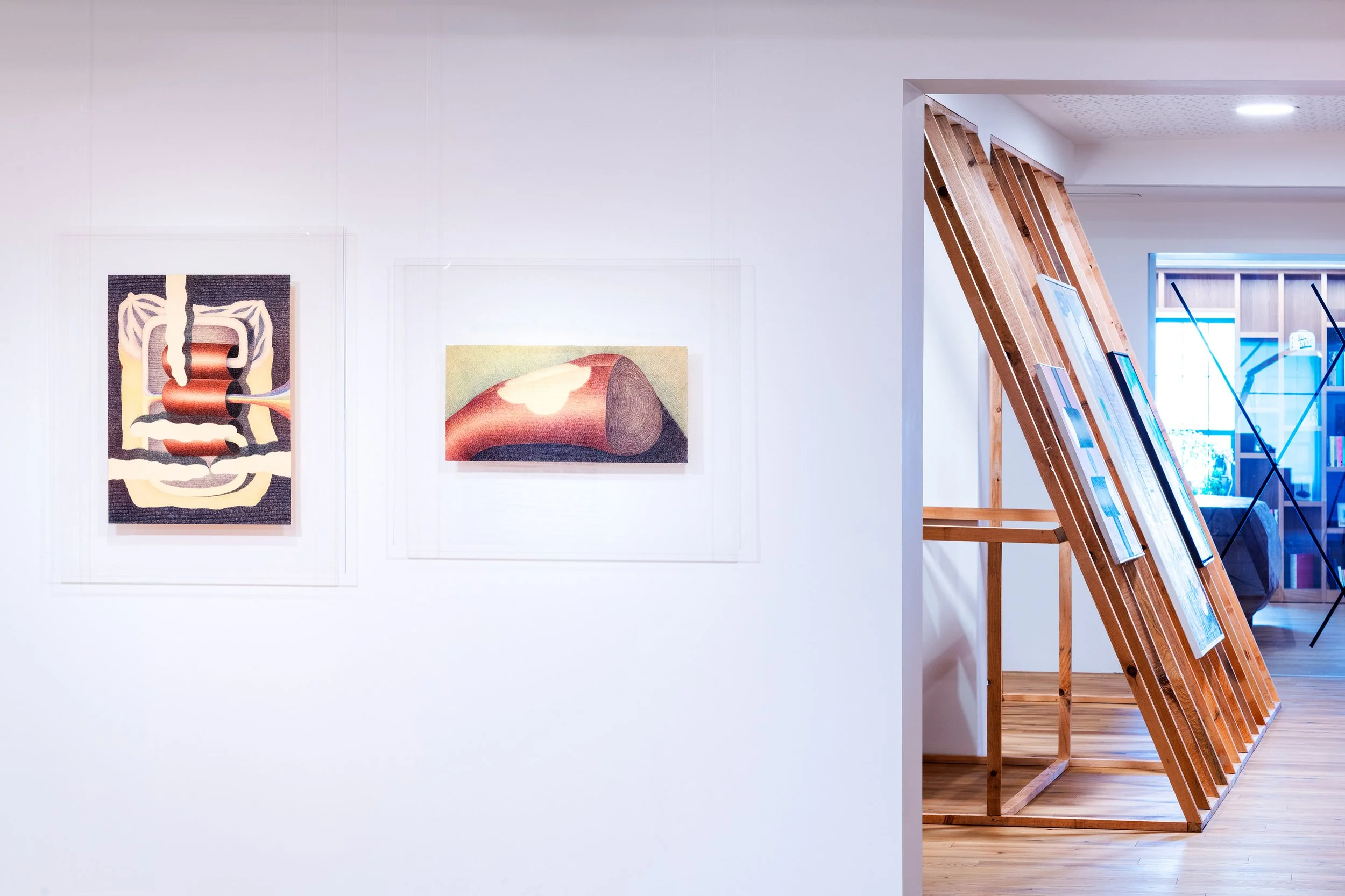
*Jolana Škachová (1998) is a young artist at the beginning of her professional career, and a graduate of the Prague art academies UMPRUM and AVU. It was during her studies at the Prague Academy that she turned away from painting and returned to colored pencil drawing—a shift that, at the time, restored a sense of ease and freedom she maintains in her work to this day. The chosen texture, format, and color of the paper serve as an environment into which she places the rough contours of her idea, which then gradually become sharper through the process of drawing. She speaks of her works more as objects, "sculpting" individual shapes into their final form and coexistence with meticulous pencil strokes. When drawing, she uses a basic color palette, layering lines in dozens of tracks to achieve the desired tone. This grants her constant control over every movement, making the process one of patient collaboration. She draws inspiration from her surroundings and a continuous flow of images and thoughts, weaving them into final scenes imbued with surreality and a near-metaphysical quality.
The title of her latest series of drawings, "Homemade Exotic," carries an inherent tension between the intimately familiar and the unexpectedly foreign. It represents an exoticism that does not await us thousands of miles away, but rather one hidden within the close observation and perception of our immediate environment. The artist captures the moment when the everyday reality of home transforms into a magical landscape of the subconscious and unexpected associations. We see a marine horizon discovered in a children's paddling pool with an inflatable shark, the surface of a dining table turning into a topographic map of potential journeys, or the folds of a dress as the embodiment of lazy heat. Hidden within the images are occasional items gathered from "summer holiday wanderings"—her own "souvenirs" that, at some point, became part of the domestic environment. Through these objects, the artist perceives the home as an active ecosystem with its own laws, mutability, and hidden life.
Anežka Chalupová, Exhibition Curator
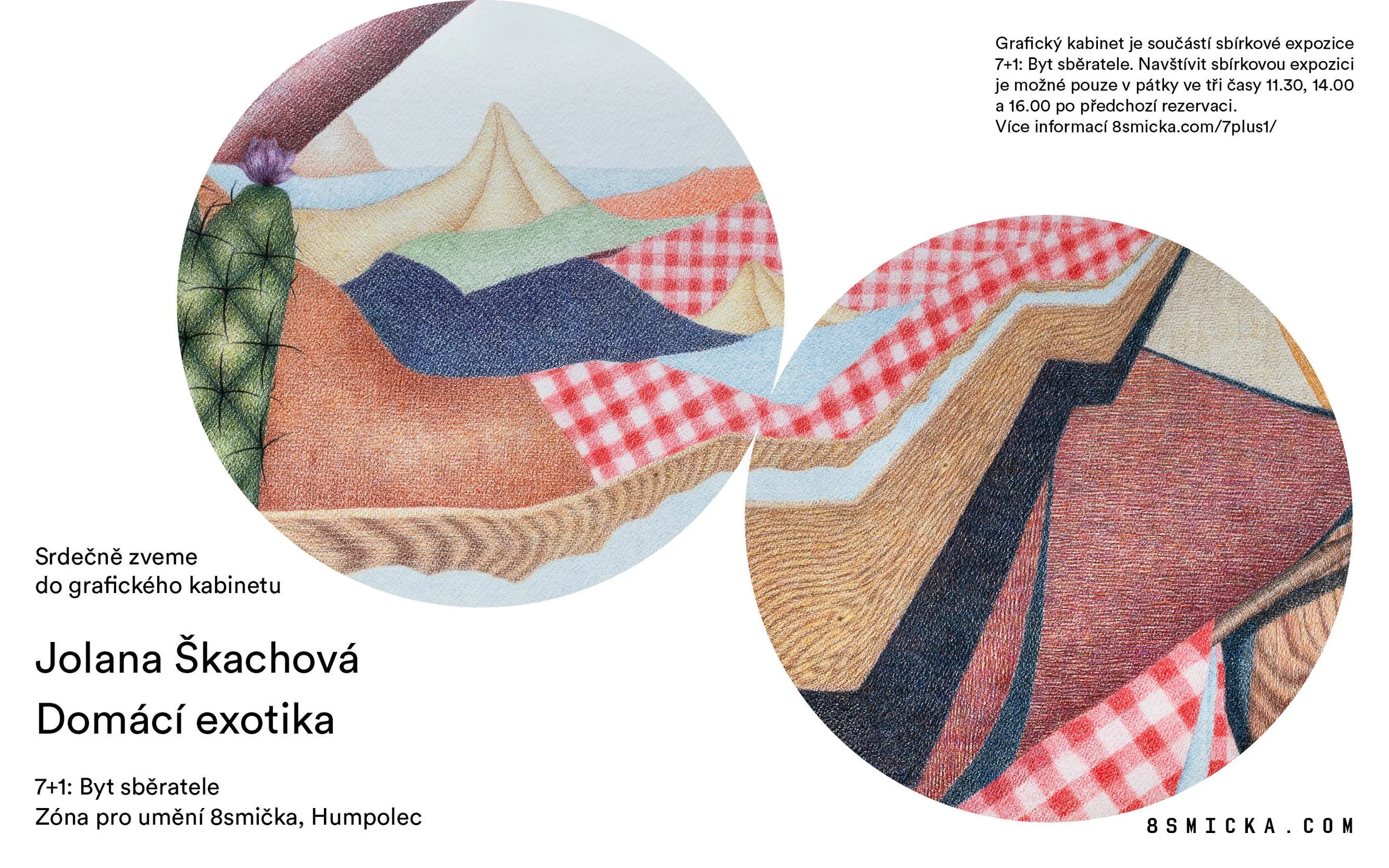
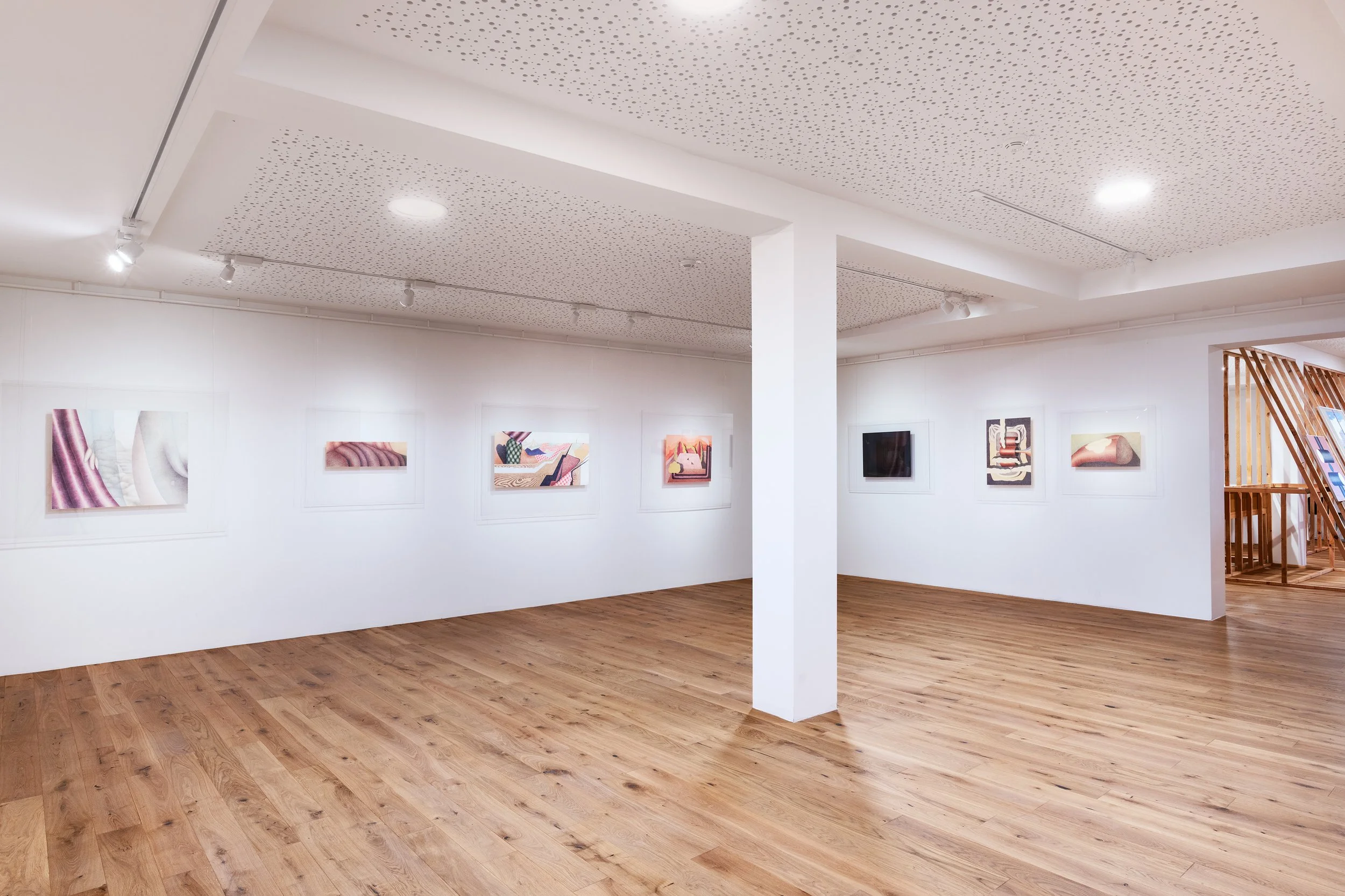
Photo © Eva Bystrianská
The Sleep of Reason
The title of the exhibition refers to Francisco Goya’s print The Sleep of Reason Produces Monsters from his famous series Los Caprichos (1793–1799). Goya’s etching captures the moment when the vigilance of reason gives way to sleep, and the mental space is seized by nightmares and terrifying visions. It is precisely this moment—when the boundaries of rationality collapse and the dark contents of the subconscious take control—that becomes the starting point for a project in which contemporary artists explore various facets of oniric states, intimate rituals, and secret mental spaces where a positivist approach clashes with the magical, archetypal images of the collective unconscious. At a time when rationality fails as a tool for a comprehensive understanding of reality, a return to intuition, imagination, and dream structures appears to be an alternative way to navigate a world that has lost both legibility and stability.
Terezie Zemánková, Mira Macík, Exhibition Curators
Exhibiting Artists
Jolana Škachová, Dana Sahánková, Jan Hísek, Jan Durina, Dominik Adamec, Dominik Styk, Karel Havlíček
J Squared
The summer August exhibition at the Spot Gallery presents a selection of works by two recent graduates of the Academy of Fine Arts in Prague – Jitka Petrášová (1981) and Jolana Škachová (1998). Thesis projects are usually a moment of taking stock of one's studies so far, as well as a significant turning point in both artistic practice and life in general. The interface between the completed school and the beginning of professional practice is separated by the "last summer holidays"—a period of accelerated personal transformation. Within it, many concurrent, contradictory processes take place, awakening rapid successions of melancholic states and insistent promises; a transformation in which the sweet timelessness vanishes. One horizon closes only for another to open. This process of taking stock is also evident in the themes and subject matter appearing in the paintings and drawings of both artists. The work of Jitka Petrášová and Jolana Škachová is different in many ways: vitally exuberant, colorful paintings stand alongside muted, drawn, temporally layered images; introspective probes into ancestral history next to explorations of the ambiguous interface between static objectivity and the dynamic experience of time and space.
While to Jitka Petrášová the world appears as an enchanting, exotic garden—where, however, one can stumble upon shadowy corners full of absurd distortions, grotesque anomalies, and poisonous vegetation that disturb the clarity of the mind—Jolana Škachová immerses herself with deep concentration into the interspace of vision and perception, capitalizing on it through a newly discovered dream morphology. For Petrášová, the "garden" is a metaphor for both family and social community, where the traces and imprints of previous generations, tied to specific places and times, overlap. Škachová, on the other hand, sees the equivalent of "home" in her emerging imagination (much like the German-Jewish philosopher Theodor W. Adorno found his "home" in writing and language). Jitka Petrášová possesses a gift for immediacy with which she reacts to internal and external impulses. Her key expressive tools are gesture and color. From a cluster of events and a plane of indistinguishability, figures, animals, flowers, environments, or places emerge before our eyes, representing the symbolic layer of the artist's personal mythology. At first glance, the world here seems almost crazily cheerful, but a second glance detects a sophisticated, ubiquitous mimicry associated with social masking and communication strategies. Banality is melted down into contradictory, provocative etudes that primarily reflect the fullness of human existence amidst an infinite wealth and diversity of phenomena. Life is a celebration of passing time, in which constructions of human ideas, dreams, and desires accumulate, but also moments of disappointment and pain that undermine these seemingly solid structures. Color here serves as an ironic smile, which, from a distanced perspective, affirms the state of affairs and shares it with the viewer.
In connection with her work, Jolana Škachová mentions the method of "guided intuition." It is precisely through this path that she reveals the hidden paradoxes of our perception, which shatters between precise details and elusive, vanishing wholes. Through a slow, drawn examination of objectivity, she evokes and explicates conscious and subliminal relationships between what is seen and what is experienced. For these, the artist finds an allegorical, fantastical morphology full of shifts in meaning and expression. With it, she also discovers a meditative interspace in which, as if in a laboratory, she observes the process of objectivity emancipating itself from its predicted utility (in terms of function) and banality (in terms of perception). The process of slowly examining relational principles and layering translucent crayon surfaces over time analogously recalls the literary techniques of Milan Kundera, which communicate the distress, complications, and anxieties of seemingly banal and straightforward situations. Beneath the surface of the "pseudo-concrete" (Karel Kosík), the world appears seductively magical, alluringly enchanting, and—paradoxically—all too terrifying in its apparent simplicity.
Petr Vaňous, Exhibition Curator